What Is a Sales Funnel? A Beginner's Guide to the 4 Stages
A sales funnel is a step-by-step process that guides someone from first hearing about your business to becoming a paying customer. Every business has some version of a funnel, whether they have deliberately built one or not. The difference between businesses that grow predictably and those that struggle is usually whether they have mapped out their funnel and optimised each stage.
The concept dates back to the early 1900s, when American advertising executive Elias St. Elmo Lewis created the AIDA model (Attention, Interest, Desire, Action). That model laid the groundwork for what we now call a sales funnel, and while the tools have changed dramatically since then, the underlying psychology is the same.
This guide covers what a sales funnel is, how each stage works, and how to build one that converts using modern tools like ClickFunnels.
The Four Stages of a Sales Funnel
A standard sales funnel has four stages, each representing a different phase of the buyer's journey. The funnel is wide at the top (many people become aware of your business) and narrow at the bottom (a smaller number actually buy). Your job as a marketer is to move as many people as possible from one stage to the next.
Stage 1: Awareness
The awareness stage is where potential customers first learn that your business exists. They might find you through a Google search, a social media post, a podcast interview, a paid ad, or a referral from someone they trust.
At this stage, the person is not ready to buy. They may not even know they have a problem your product solves. Your goal is simply to get in front of them and make a strong first impression.
Common tactics for the awareness stage include:
- Content marketing - Blog posts, videos, and infographics that answer questions your target audience is searching for
- SEO - Optimising your website so it appears in search engine results for relevant keywords
- Social media - Building a presence on platforms where your audience spends time (Facebook, Instagram, LinkedIn, YouTube, TikTok)
- Paid advertising - Running targeted ads through Google Ads, Meta Ads, or other platforms to reach new audiences
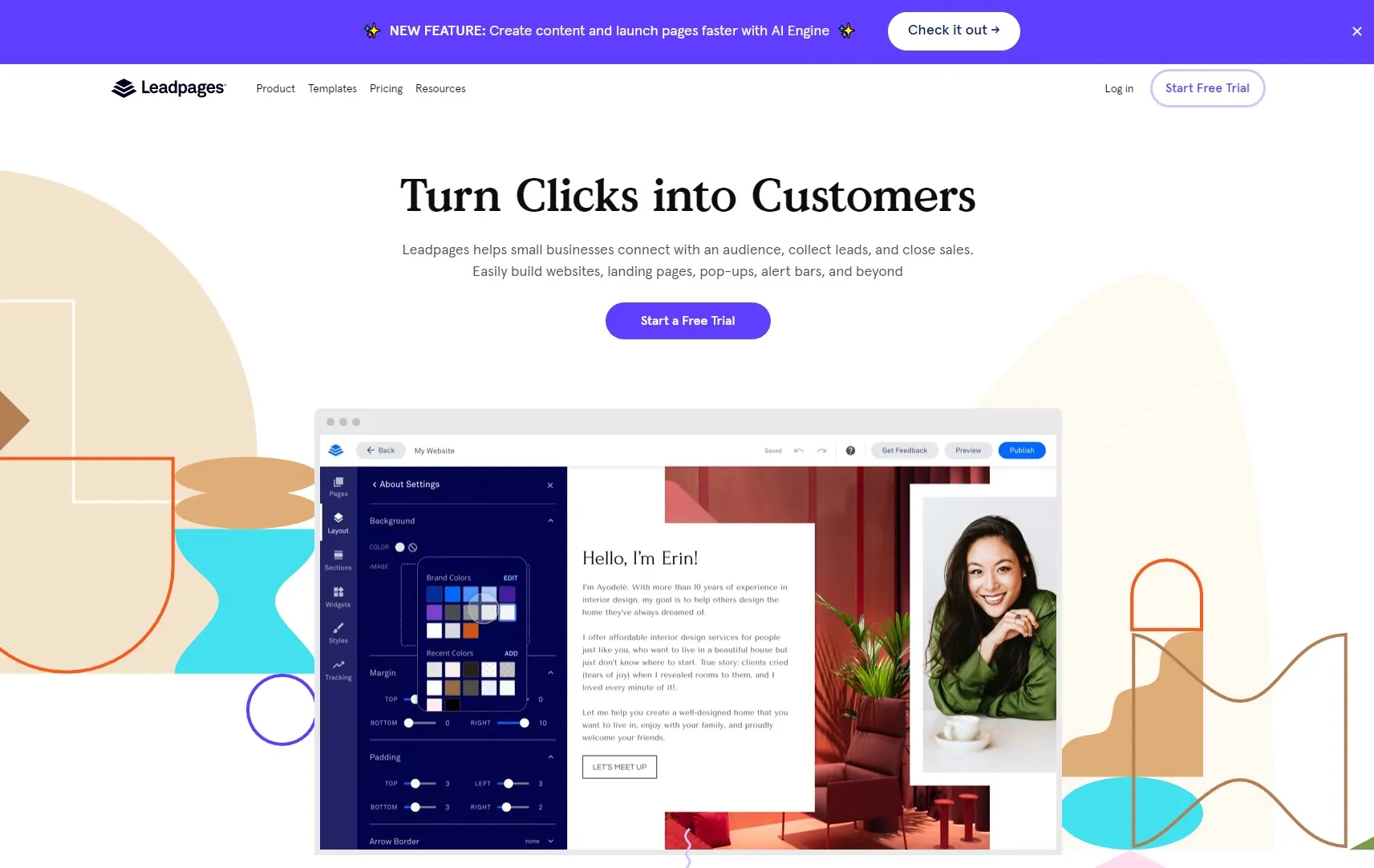
- Landing pages - Creating dedicated pages with a clear message and call to action, rather than sending traffic to a generic homepage. Learn more about what a landing page is and why it matters
The key at this stage is to provide genuine value without asking for a sale. You are building trust and establishing your brand as a credible source.
Stage 2: Interest
Once someone is aware of your business, the next step is to develop their interest. At this stage, the potential customer is actively researching solutions. They are comparing your product to competitors, reading reviews, and trying to determine if what you offer is the right fit.
Your goal during the interest stage is to stay in front of them and demonstrate that you understand their problem better than anyone else.
Effective strategies for the interest stage include:
- Email marketing - Capture email addresses through lead magnets (free guides, checklists, webinars) and nurture those leads with a sequence of valuable emails
- Social media engagement - Respond to comments, answer questions, and share content that deepens the relationship
- Case studies and testimonials - Show real results from real customers to build credibility
- Webinars and demonstrations - Give potential customers a deeper look at your product or expertise
Russell Brunson's DotCom Secrets covers the interest stage in detail, explaining how to structure your value ladder so that each piece of content naturally leads the prospect closer to your paid offer.
Stage 3: Decision
The decision stage is where the prospect evaluates their options and chooses whether to buy from you, a competitor, or nobody at all. This is the stage where most businesses lose sales, usually because they fail to address objections or make the buying decision feel risky.
Strategies for the decision stage include:
- Discounts and limited-time offers - Create urgency without being manipulative
- Product demonstrations - Let the prospect see exactly what they are getting before they commit
- Customer testimonials and case studies - Social proof from people similar to the prospect
- Free trials - Let the prospect experience the product risk-free (for example, the ClickFunnels free trial gives you 14 days to test the platform)
- Money-back guarantees - Remove the financial risk of the purchase
The goal at this stage is to make the buying decision as easy and low-risk as possible.
Stage 4: Action
The action stage is where the prospect becomes a customer by completing the purchase, signing up for a service, or subscribing to a membership. Your focus here is on making the transaction smooth and frictionless.
Key elements of a strong action stage include:
- A clean, distraction-free checkout page
- Multiple payment options (credit card, PayPal, payment plans)
- Clear pricing with no hidden fees
- A confirmation page that reinforces the customer's decision and sets expectations for what happens next
After the purchase, the funnel does not end. The most profitable businesses continue nurturing customers through onboarding sequences, follow-up emails, and ongoing engagement. Repeat customers and referrals are where the real profit lives.
Types of Sales Funnels
Not all sales funnels look the same. The structure of your funnel depends on what you are selling, your price point, and how your customers prefer to buy. Here are the most common types:
- Lead generation funnel - Captures email addresses in exchange for a free resource (PDF guide, checklist, video training). The follow-up email sequence then moves leads toward a purchase.
- Webinar funnel - Drives registrations for a live or automated webinar where the presentation itself is the sales mechanism. Russell Brunson's Perfect Webinar framework is the most well-known example.
- Product launch funnel - Builds anticipation for a new product through a series of pre-launch content pieces before opening the cart for a limited time.
- Tripwire funnel - Offers a low-cost product ($7-$47) to convert a lead into a buyer, then presents upsells and higher-ticket offers.
- High-ticket funnel - Uses an application form and sales call to qualify and close prospects for premium products or services ($2,000+).
- Membership funnel - Sells access to a recurring membership site with ongoing content, community, or software access.
Why Sales Funnels Matter
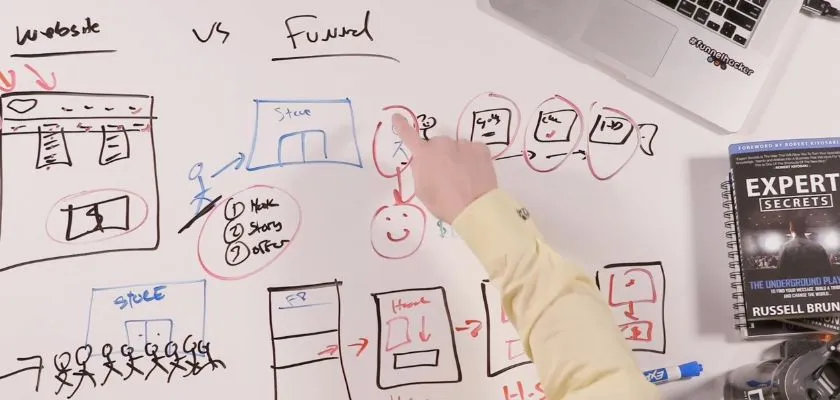
Without a funnel, your marketing is a collection of disconnected activities. You might be running ads, posting on social media, and sending emails, but if those activities are not connected in a logical sequence, you are leaving money on the table.
A well-built funnel does three things:
- It gives you clarity - You know exactly what happens at each stage and what metrics to track
- It identifies problems - If your conversion rate drops between interest and decision, you know where to focus your improvements
- It scales predictably - Once a funnel is converting, you can increase your ad spend or traffic and predict how much revenue that will generate
Building a Sales Funnel with ClickFunnels
ClickFunnels is one of the most popular tools for building sales funnels because it handles every stage in a single platform. Instead of stitching together a landing page builder, email marketing tool, checkout system, and membership platform, ClickFunnels provides all of those under one roof.
What you can build with ClickFunnels:
- Landing pages and opt-in pages for the awareness stage
- Email automation sequences for the interest stage
- Sales pages and webinar funnels for the decision stage
- Checkout pages with one-click upsells for the action stage
- Membership sites for post-purchase delivery and retention
The platform includes pre-built funnel templates for every funnel type listed above, so you do not have to start from a blank page. You can see a ClickFunnels demo to get a feel for how the builder works.
If you are new to funnels, start with a simple lead generation funnel: a landing page that offers a free resource in exchange for an email address, followed by an automated email sequence that introduces your paid product. Once that is working, you can add complexity with upsells, webinar funnels, and multi-step sequences.
Optimising Your Sales Funnel
Building a funnel is step one. Optimising it is where the real results come from. Here are four strategies for improving your funnel's performance:
-
A/B testing - Test different headlines, page layouts, email subject lines, and calls to action. Small changes can produce significant improvements in conversion rates.
-
Tracking metrics at each stage - Monitor key numbers including website traffic, opt-in rate, email open rate, click-through rate, sales page conversion rate, and checkout completion rate. If you know where people are dropping off, you know what to fix.
-
Gathering customer feedback - Ask customers why they bought (and ask non-buyers why they did not). The answers will reveal objections and friction points you may not have considered.
-
Aligning sales and marketing - Make sure everyone on your team understands the funnel and their role in it. Disjointed messaging between marketing content and sales conversations is one of the most common reasons funnels underperform.
Conclusion
A sales funnel is not a complicated concept. It is a structured way of guiding someone from "I have never heard of you" to "I just bought your product." The four stages (Awareness, Interest, Decision, Action) give you a framework for understanding where your customers are in their journey and what they need from you at each step.
The businesses that grow consistently are the ones that build, measure, and optimise their funnels deliberately. Tools like ClickFunnels make the building part straightforward, but the strategic thinking behind your funnel is what ultimately determines your results.
If you are ready to build your first funnel, the ClickFunnels free trial is the simplest way to get started without any financial commitment.